

Maths
Vision
At Holly House School, we believe that mathematics is an essential life skill that empowers learners to participate successfully in everyday life, develop independence and access future opportunities. We strive to provide all pupils with a meaningful, ambitious and inclusive mathematics curriculum that recognises their individual starting points and supports them to make sustained progress. We understand that mathematical development extends beyond number work and includes the foundational skills that enable learning to take place. Through the explicit teaching of foundational skills alongside strand-specific mathematical knowledge, we aim to equip pupils with the confidence, resilience and problem-solving skills needed to navigate the world around them. Our vision is for every learner to develop mathematical understanding that is purposeful, relevant and transferable, enabling them to apply their learning across the curriculum, within the community and throughout their future lives.
Intent
Our bespoke mathematics curriculum is designed to provide learners with the knowledge, skills and understanding required to become confident and independent mathematicians. We aim to deliver a broad, balanced and ambitious curriculum that is carefully matched to learners' developmental stages while maintaining high expectations for all. The curriculum is intended to: • Develop secure foundations in mathematical learning through the explicit teaching of prerequisite skills including attention, imitation, matching, sorting and spatial awareness. • Build fluency, reasoning and problem-solving skills through carefully sequenced learning experiences. • Ensure pupils experience a curriculum that is relevant to their age, ability and future aspirations. • Enable learners to apply mathematical skills in functional and real-life contexts both within and beyond the classroom. • Promote deep understanding through small-step progression and repeated opportunities for retrieval, consolidation and generalisation. • Provide access to National Curriculum mathematics at an appropriate stage for each learner, rather than being limited by chronological age. • Foster confidence, curiosity and enjoyment in mathematics whilst preparing learners for future learning, employment and independent living. Financial literacy and life skills mathematics are embedded throughout all areas of the mathematics curriculum, enabling pupils to apply their learning in meaningful and functional contexts. Alongside this, dedicated financial literacy units are taught each term, providing focused opportunities to develop life skills such as budgeting, handling money, telling the time, shopping and making informed decisions. This ensures learners are equipped with the mathematical knowledge and confidence needed for everyday life and future independence. The curriculum recognises communication as the foundation of learning and ensures mathematical understanding is developed through meaningful discussion, practical exploration and active participation.
Implementation
Our mathematics curriculum for Key Stage 2 and Key Stage 3 has been carefully designed using evidence-informed practice and nationally recognised frameworks including the National Curriculum, White Rose Maths, NRICH, NCETM guidance and Education Endowment Foundation recommendations. Teaching is underpinned by the Concrete–Pictorial–Abstract (CPA) approach to support conceptual understanding and long-term retention. These documents have informed the sequencing of learning, curriculum content and pedagogical approaches, ensuring that learners receive a coherent, ambitious and accessible mathematics curriculum that develops secure foundations before progressing to increasingly complex mathematical concepts. The curriculum is delivered through nine key mathematical focus areas which provide the foundations and progression routes for learning:
Foundational Skills
- Attending
- Imitation
- Matching
- Sorting
- Spatial Orientation
Mathematics Strands
- Number
- Measure and Geometry
- Statistics and Probability
These strands are further broken down into carefully sequenced sub-strands, allowing pupils to develop knowledge and skills through small progressive steps. Key content areas include:
- Number and Place Value
- Number Facts
- Addition and Subtraction
- Multiplication and Division
- Fractions
- Measurement
- Geometry
- Statistics
- Financial Literacy
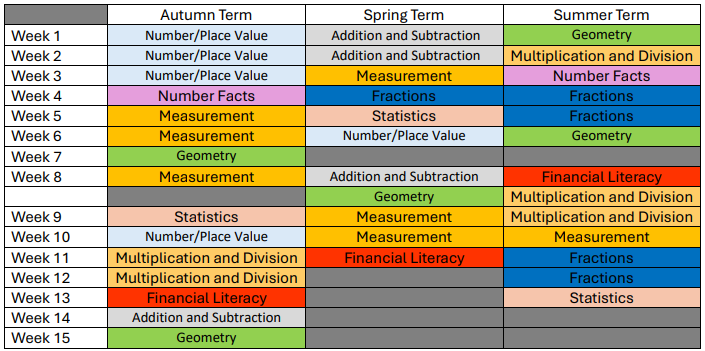
These nine strands are generally visited every single term by every maths group, please see the overview table at the bottom of the page. Pupils develop the confidence and ability to use mathematics in real-life situations. Through both discrete financial literacy units and the ongoing application of life skills across all mathematical strands, learners strengthen their understanding of money, time, measurement and problem-solving. This supports greater independence, informed decision-making and preparation for adulthood. Mathematics is taught through timetabled lessons with learning organised into focused strand blocks. These blocks allow pupils to develop knowledge, practise skills and apply learning in a range of contexts before moving on to new content. Previously taught learning is revisited regularly through retrieval practice and consolidation opportunities to strengthen long-term memory. Teaching is adapted to meet individual needs, ensuring learners can move through the curriculum at an appropriate pace while securing understanding before progressing. Mathematical skills are also reinforced across the wider curriculum to support generalisation and functional application. Assessment is integral to implementation. Learners complete baseline assessments on entry, and ongoing formative assessment, teacher observation, questioning, work scrutiny and retrieval activities are used to inform teaching. Progress is reviewed through termly assessment points and continuous teacher assessment. Leaders monitor curriculum effectiveness through lesson visits, moderation, assessment analysis, work scrutiny and pupil voice.
Impact
Our mathematics curriculum enables learners to develop secure mathematical foundations and make meaningful progress from their individual starting points. Through carefully sequenced learning and a strong emphasis on foundational skills, pupils build the confidence and competence required to engage successfully with increasingly complex mathematical ideas. As a result of our curriculum, pupils:
- Demonstrate increased mathematical fluency, reasoning and problem-solving skills.
- Apply mathematical knowledge across different subjects and real-life situations.
- Develop greater independence in everyday tasks involving number, measurement, time, money and data.
- Retain and recall prior learning effectively through retrieval and consolidation opportunities.
- Build resilience, confidence and positive attitudes towards mathematics.
- Are able to generalise mathematical skills beyond the classroom and into wider community contexts.
- Access an ambitious curriculum that supports preparation for future learning, employment and independent living.
Leaders can evidence the impact of the curriculum through assessment outcomes, lesson observations, work scrutiny, pupil voice and progress over time. The curriculum ensures that learning remains responsive to pupils' needs whilst maintaining high aspirations and enabling all learners to achieve success in mathematics.
Strands Visited in each term:
Maths - Curriculum Delivery
maths curriculum delivery sets 1 to 6.pdf
Maths - Knowledge and Skills Progression
This is shown by the maths strand - Each strand has its Knowledge and Skills and is on a separate document.
Number and Place Value
number and place value maths knowledge and skills mapping.pdf
Number Facts
number facts maths knowledge and skills mapping.pdf
Addition and Subtraction
addition and subtraction maths knowledge and skills mapping.pdf
Multiplication and Division
multiplication and division maths knowledge and skills mapping.pdf
Fractions
fractions maths knowledge and skills mapping.pdf
Measurement
measure maths knowledge and skills mapping.pdf
Geometry
geometry maths knowledge and skills mapping.pdf
Statistics
statistics maths knowledge and skills mapping.pdf
Financial Literacy
financial literacy maths knowledge and skills mapping corrected.pdf
